
Dreaming of a Common Language
Re-reading a poem with 25 or 45 years of life behind me

Aloha! Welcome or welcome back. I am so grateful to have readers who allow me to think out loud through my writing. One long-time sister-friend, a friendship whose origin story did appear back in the sequential section of this memoir, told me recently that in anthroposophical thought it is only at the age of 63, completing nine cycles of seven years, that an individual truly comes into understanding their lifeʻs purpose. That tracks for me and probably is one reason why Iʻm looking back at the lessons that got me here.
My hope is that it also inspires you, at whatever stage of life is yours to inhabit, to know that you have a purpose. And encourages you to keep digging into that purpose, to welcome the teachers you need, to keep allowing its expression to unfold.
I had so much to say last week about the intersection in my thoughts between poet Adrienne Rich (whose poetry I was intending to write about) and actor Diane Keaton (whose films I was binging in honor of her passing). So much that it needed a part two this week. So letʻs go back to the late 1970s (in memory for some of us, in imagination for those of you who were not yet born…)
Thinking to review my college and immediately post-college years through the poetry that influenced me, I re-read the poems in Richʻs 1978 collection The Dream of a Common Language. These poems are arranged in three thematic sets: Power, Twenty-one Love Poems, and Not Somewhere Else, But Here. At the time, the first and third parts were deeply and readily resonant for me. They still are. The Love Poems were uncomfortable for me when I first read them, no corners of pages turned down, no slim bookmarks left behind. I found a new appreciation for them at re-reading, which is one of the joys of returning to poems over and over again.
There are love poems as well in the first and third sections, in the sections one might describe as being about women and/in Power, and about women and/in Nature. To be clear, the entire book of poems is an exploration of love between women in its many dimensions, from the very first love of our lives in the mother-daughter bond, to the bonds of affection between “sisters” both biological ones and kindred spirits, to women as lovers and partners in a primary committed relationship.
But letʻs take this from the top.
Power
To dream of a common language is a power move. I recently wrote a whole series of essays about language and power so rediscovering Richʻs exploration was a happy coincidence (you know I donʻt believe in those). In these four installments I asked and mused about:
And explicitly about Words and Power
Taken together, Richʻs poems on Power contrast the poisonous results of achievement as measured in the “menʻs world” where in my 20s and 30s I was striving to succeed1 with the intimation that the blueprint for a world of dignity and well-being for all begins with womenʻs language and experience. In the poems, Marie Curie dies of radiation poisoning; an all-women climbing team freezes to death on Leninʻs Peak. But in Hunger, Rich writes:
“The decision to feed the world
is the real decision. No revolution
has chosen it. For that choice requires
that women shall be free.
I choke on the taste of bread in North America
but the taste of hunger in North America
is poisoning me.2
I think of the language used in my current professional world. I think of the difference that is more than “just linguistic” between approaching the work as land conservation versus land back versus rematriation.
As I welcome a poem that makes me uncomfortable, I welcome the poetry of the term rematriation in the ability of that poetic word to make me uncomfortable. The comfort zone - it isnʻt working, it wasnʻt working, it is not where I/we will find solutions.
“Land” as ʻāina feeds its community. Land as a bundle of property rights leaves the poisonous taste of hunger in my mouth.3
Twenty-one Love Poems
In this volume of poetry for the first time Rich discovers and reveals herself as a lesbian. Just as her previous poems explored the oppressions of class and gender and race relations, she now explores with piercing vulnerability how disapproval of her relationship and sexual orientation damages that loving relationship. She documents frustration that goes beyond that of not having her experience as a woman validated by society, namely the doubled pain of her experience specifically as a woman loving another woman not being accepted and recognized by society.
At the time I first read these poems in the 1970s, I had a handful of friends who were “out,” who were openly gay and lesbian and bi-sexual. But only the handful who had not gone into conventional professions. I knew more who married, who tried to make a conventional relationship work. Later, as I wrote in this memoir, by the 1990s I was living in Greenwich Village in the middle of the AIDS crisis - and still there was not a single openly gay man or woman working at the Bank with me.
I am happy that the outer world has changed. That there is a month celebrating Pride. I fear the threats of sliding back into oppression of LBGTQ individuals. I will stand alongside my friends and colleagues and clients to defend their right to love who they love and their right to their own gender and sexual identity.
I am happy also that my inner landscape has changed. It took decades more of my personal evolution, and perhaps the evolution of the queer community in all its glorious diversity, for me to begin to deeply appreciate what Rich is hinting at: how all versions of loving relationships between two women help me and other women understand what it is to be a woman, to identify as a woman.
Relationships which are by definition outside of the patriarchal, capitalistically driven nuclear family norm often give me insight into ways in which I could re-imagine, re-invent my concept of being a woman in sexual and romantic partnership with a man, that being my preference. Healthier ways of being in partnership. Freer ways of mutual discovery and expression inherent in relationship of all kinds.
Not Somewhere Else, But Here
The third section of The Dream of a Common Language begins with a poem about the pain of the end of a relationship. I was surprised to recognize the similarity of words I put to my own experience in Lava, the poem I wrote in 1992 and shared here in December 2022.
Rich writes in Not Somewhere Else, But Here:
“Spilt love seeking its level flooding other
lives that must be lived not somewhere else
but here seeing through blood nothing is lost”
From there the settings of Richʻs poems move from Upper Broadway, our beloved Manhattan, to our beloved natural environments. In these poems, her imagery and language shifts into the geographical and metaphorical territory of my other early core poets: Joy Harjo, Mary Oliver, Louise Erdrich. The solace of the natural world; the lessons in its rhythms.
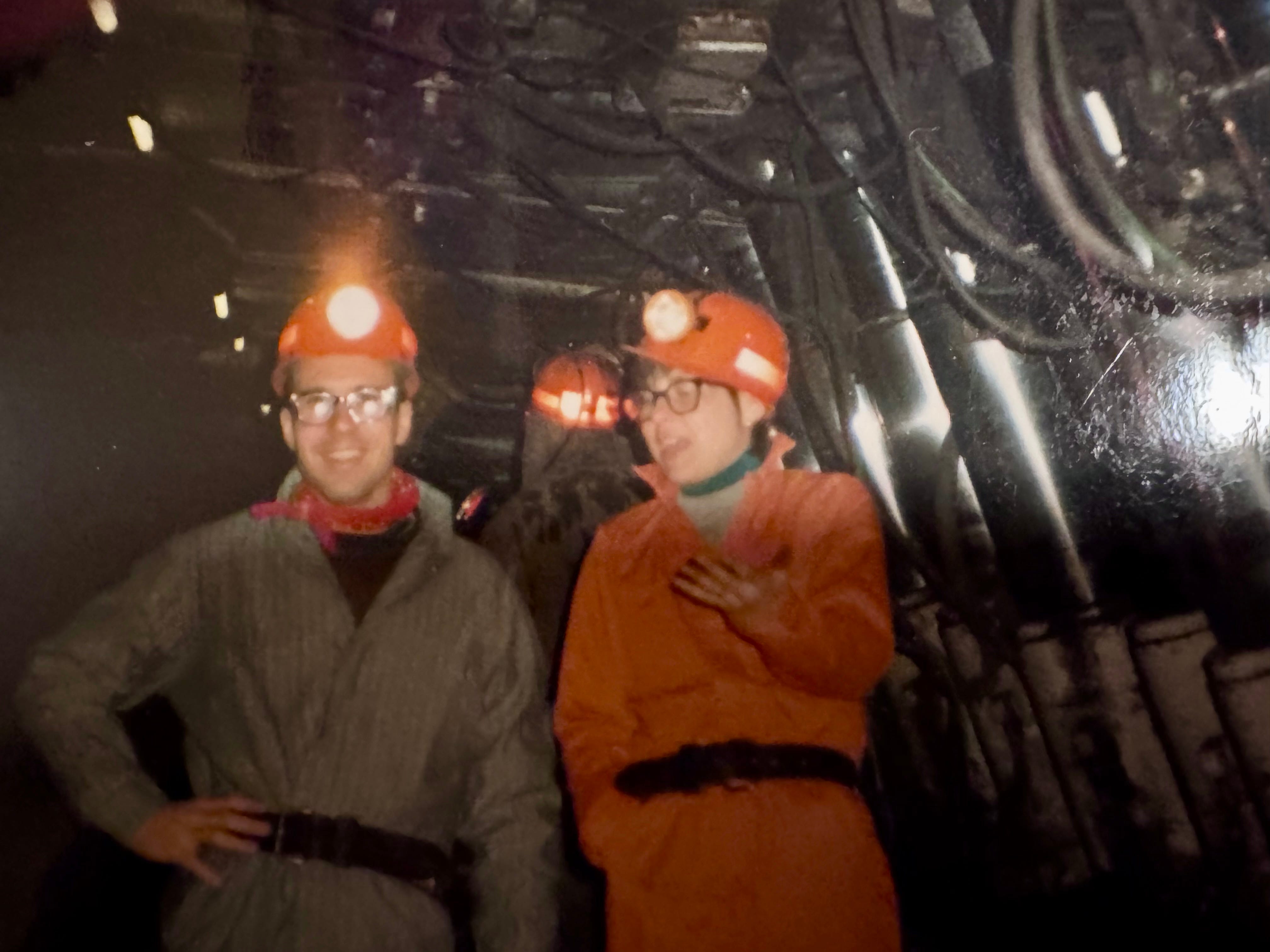
I found a receipt tucked into the pages of this book, perhaps the receipt from its purchase although it is too faded for me to make out any details. The receipt marks a poem titled Natural Resources. A poem I had forgotten, perhaps had forgotten or committed to my subconscious brain before, in the early 1980s, I physically and professionally entered the world it describes, becoming the thirteenth woman to ever earn a Ph.D. from Colorado School of Mines.
“The miner is no metaphor. She goes
into the cage like the rest, is flung
downward by gravity like them, must change
her body like the rest to fit a crevice”
Many stanzas and pages later, the poem Natural Resources concludes much as my journey into my own personal shipwrecks and down actual mine shafts has brought me around to this perfectly expressed commitment:
“My heart is moved by all I cannot save
so much has been destroyed
I have to cast my lot with those
who age after age, perversely,
with no extraordinary power,
reconstitute the world.
Seriously, can a choice of professional fields be any more perversely male dominated than working on Wall Street at mergers and acquisitions for mining companies in the 1980s?
Here in Hawaiʻi, 30% of families are food insecure. Parents skip meals to be able to feed their children. The programs that remedy this, both those providing food directly to those who cannot afford to buy it, and those supporting local agriculture to be consumed locally, are in danger as federal funding is being cut drastically.
I explored those distinctions in this post Another Look at Place.