
Thatʻs How the Light Gets In
The Hopeful and Enlightened Poetry of Leonard Cohen

Despite my ambivalence about the “festive season” I still wish you the warmth of happy times with family and friends or with your own good company and a quiet moment. And I am still grateful to you for reading. Mahalo for being here three years into my project.
The next poet in this series within my memoir-in-essays was going to be Mary Oliver. Thatʻs what I had planned anyway but the essay kept getting postponed. This writing thing is always mysterious. Another poet wanted to come first.
The mind cannily compartmentalizes, in this case, “poet” versus “singer-songwriter.” But the higher mind also knows better. A few days ago Facebook served up a memory from November 23, 2013. In November 2013, I (by which I mean we - myself and the Swiss Guy attempting to save our marriage by escaping from the pattern of our days), I/we had traveled all the way to the Hunter Valley in New South Wales to imbibe Shiraz and Semillon and to hear Leonard Cohen perform at Bimbadgen Winery on his final world tour promoting his album Old Ideas.
Leonard Cohen was 79, still in control of the stage, graciously giving primetime and his greatest hits to other musicians and voices as he sang of his own passing and elegantly passed the mantle, acknowledging that there were already a dozen cover albums, hundreds of recorded covers of his songs. That was how he would live on.1
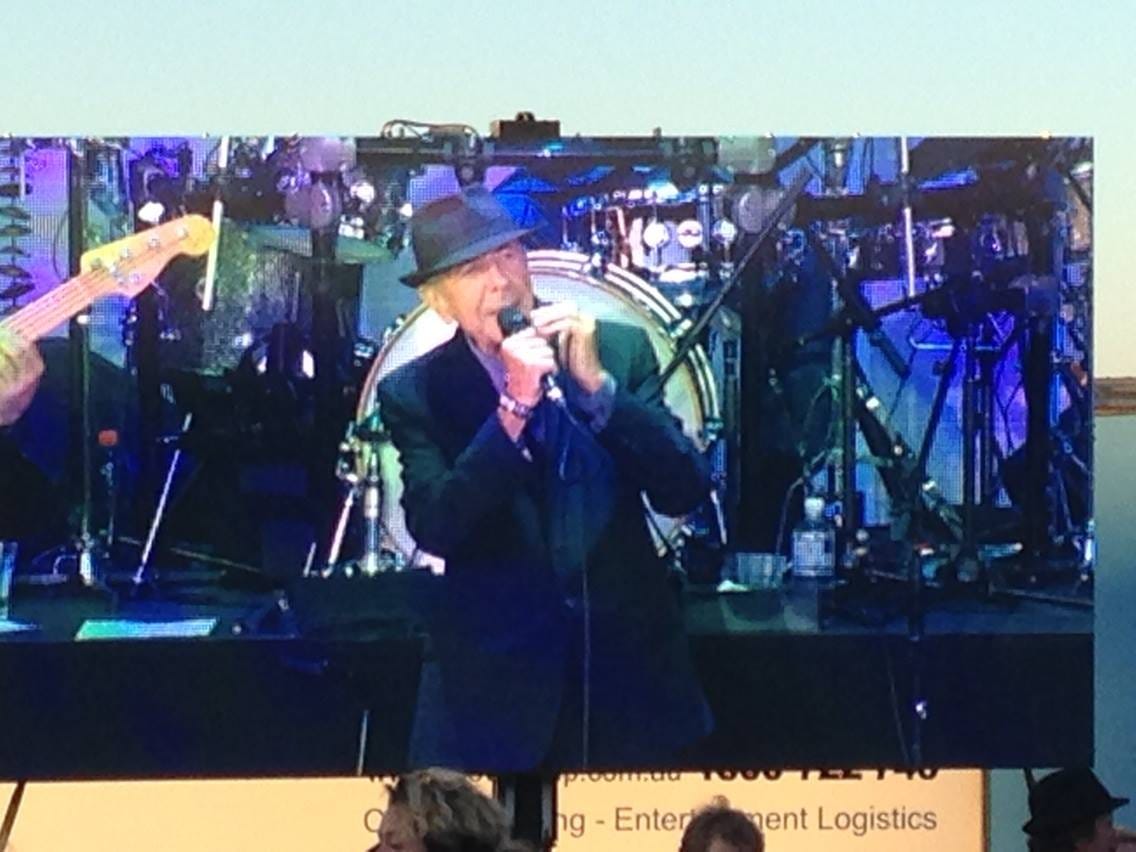
I smiled at the Facebook memory but I did not quite get the message. So the next day came another tap on the shoulder when someone recommended the new album Sad and Beautiful World by Mavis Staples. Mavis Staples is 86 years old. They say she dated Bob Dylan, another of those my mind needs to stop worrying about categorizing between poet and songwriter.
Back to Mavis and the Staple Singers and my memories of the music of the Vietnam War era. Gospel, rhythm and blues, folk, protest - is there really any difference? Stop categorizing already. Anyway I did crank up the new album on Spotify as I hummed and danced around the kitchen (I mean, as I cooked dinner), and there it was, a cover of Leonard Cohenʻs Anthem.
Head slap emoji. I hear you already. Finally.
The funny thing about my “hopeful and enlightened poetry” subtitle for Leonard Cohen is that when his first albums were released, we (myself and my young contemporaries) thought of him as a pessimist. That suited us. This was the late 60s and early 70s, we were teenagers, and therefore inherently critics, sullen optimists masquerading as pessimists. Of course we loved the poetry of Dylan and Cohen.
We were too young to understand they werenʻt just cynics, and they were not pessimists. They were, as it turns out, prophets. The slightly older big brothers who were among the prophetic poetic voices that shaped me.
In 1992 I went on the trip to Tibet with which I began this memoir.2 Also in 1992, Leonard Cohen released his album The Future, on which the song Anthem appears. The title track, The Future, is as dark as he gets. As dark as today sometimes feels if I go down the rabbit hole of the news as served up by my social media algorithms. But there in the middle, the fifth track if you keep listening3, there is Anthem. Hope appears. The prophetic voice appears.
Some say the song was inspired by Kabbalistic mysticism. Perhaps. He was definitely a seeker. What I do know is two years later, in 1994, Leonard Cohen entered the monastery at Mt Baldy Zen Center in Los Angeles. Sometimes in his songs you find the Jewish fatalism that can in popular culture sound like pessimism, the Jewish mysticism of his heritage. In his songs from this point forward you also find the Buddhist premise: a clear eyed patient acceptance that life sucks, pain and death are inevitable, and because there is a cause of our suffering that is under our control, there is therefore a pathway out of it.
If you have been reading here for a while you know that for me that is a core belief, that is our job here in these bodies to embody love and acceptance and be a pathway for others to find the pathway of love and acceptance and liberation.
Here are the exhortation and the conclusion everyone remembers from Anthem, even if they remember nothing else:
Ring the bells that still can ring
Forget your perfect offering
There is a crack, a crack in everything
That’s how the light gets in
Ring the bells.
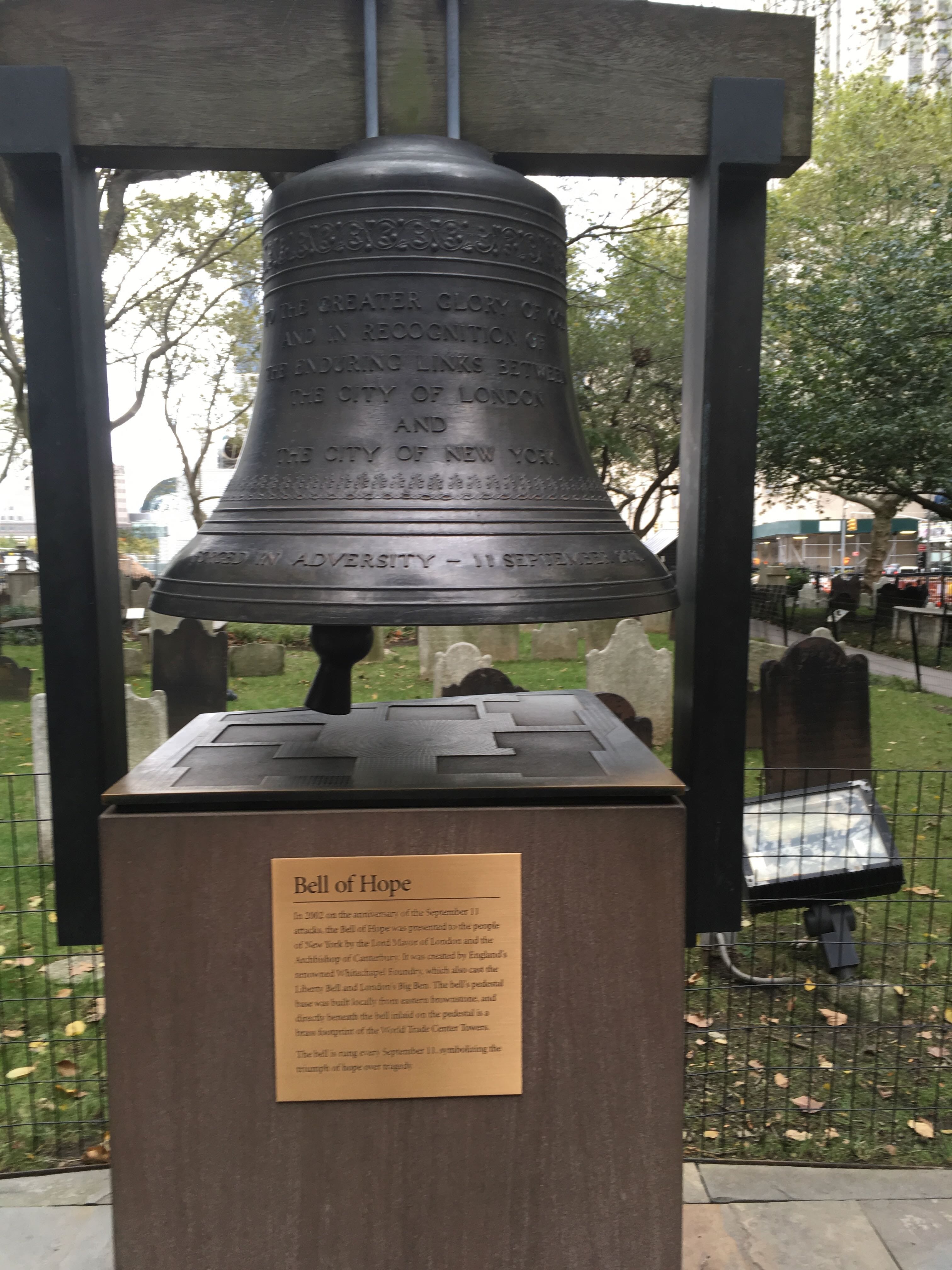
Every year on September 11th at 8:46 am, the Bell of Hope behind St Paulʻs Chapel in Lower Manhattan is rung.4 The Bell of Hope. The metaphor of ringing bells is a powerful one for me. Hope is of necessity a wake up call, the sound of birds singing the new day into being, every blessed day of Creation.
With my morning practice of gratitude and asking the Divine for help for others and for myself, I commit to ring the Bell of Hope inside myself every day. Sometimes it kind of thuds, but on those days I know all I have to do is to look for the less than perfect offering. To remember that whatever I do in this moment to accept the world as it is and to accept myself as I am, to know I do not have to have it worked out, to know I do not have to be good enough to save anyone or anything let alone everyone and everything, is to allow myself to be a bell that still can ring, to be a bird that still can sing.
To offer imperfect presence and commitment in everyday moments is what I can do. To offer myself with my imperfection but also with consistency and with courage is what I can do.
Anthem is a gift of hope. The Bell of Hope is a gift of poetry. The poetry that is Leonard Cohenʻs imperfect offering is a gift of hope.
Letʻs dwell in hope. Even if you listened to it once, just listen again to Mavis Staples singing Anthem. Please. And please pass it on. Please share the gift of hope.
Leonard Cohen “went home” three years later. From Going Home, the first song on the Old Ideas album:
Going home
Without my burden
Going home
Behind the curtain
Going home
Without the costume
That I wore
Here are the shortcuts to that story: What Happened Before Tibet Happened, Twenty Days in Tibet, Nine Days in Shoto Terdrom
Track 5 before Track 6, before the drums that begin the song Democracy. Let this be a prophetic voice. Are we truly the “cradle of the best and the worst”?
Sail on, sail on
O mighty ship of state!
To the shores of need
Past the reefs of greed
Through the squalls of hate
Sail on, sail on, sail on..
The Bell of Hope was a gift from the City of London, presented in 2002 by the Mayor of London - and by the then Archbishop of Canterbury George Carey, right before Rev. Rowan Williams was appointed to succeed him. The Reverend Rowan Williams with whom I spent September 11, 2001.
Great choice of subject(s). Glad you went in this direction.
Sweet reflections. thank you